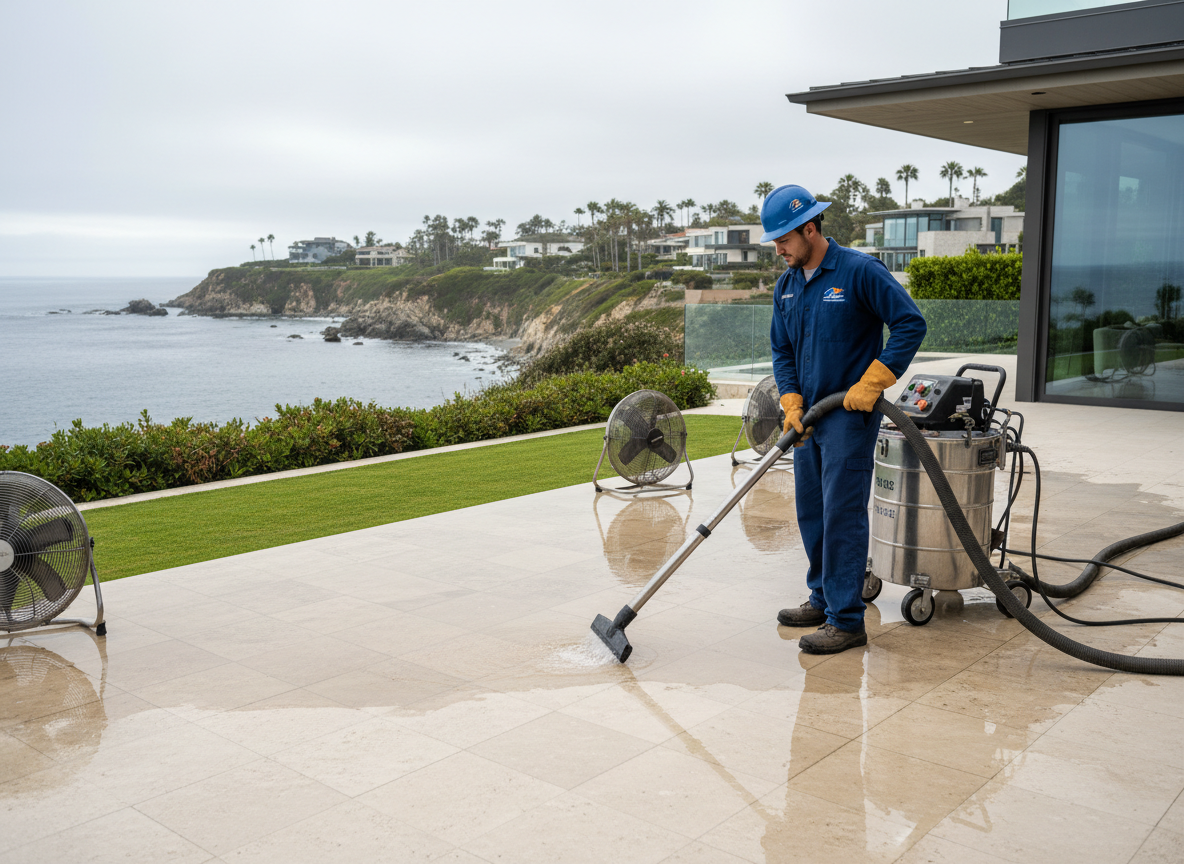
Water damage mitigation in Palos Verdes Peninsula begins with rapid containment to limit spread through older stucco and plaster homes common in Palos Verdes Estates and Rolling Hills. Ocean breezes in the mild Mediterranean climate keep ambient humidity elevated year-round, which slows evaporation and requires industrial dehumidifiers sized for the square footage plus targeted air movers directed at subfloor cavities. Technicians inspect for hidden moisture behind built-in cabinetry and along hillside retaining walls that channel runoff toward foundations in Portuguese Bend.
Edge cases arise when leaks originate near Terranea Resort-area properties where salt air accelerates corrosion on metal lath and electrical boxes. Los Angeles County building codes require documentation of moisture readings below 15 percent before drywall replacement proceeds, and crews document every step to support insurance claims. Homeowners often overlook condensation forming on chilled pipes during the cooler marine layer nights, allowing water to drip into wall cavities undetected for weeks.
Mitigation crews prioritize isolating affected zones with plastic barriers to protect unaffected rooms in multi-level homes typical of Rancho Palos Verdes. Extraction focuses first on standing water using truck-mounted units, followed by drying that accounts for the area's consistent ocean influence rather than inland heat. This approach prevents mold colonies from establishing in the porous soils and crawl spaces found throughout Lunada Bay and Abalone Cove neighborhoods.
Technician insight
In Palos Verdes Peninsula, the thing that catches most people out with water damage mitigation is the way ocean breezes keep humidity high inside older hillside homes in Portuguese Bend and Rolling Hills Estates. Homeowners shut off the water and assume drying will finish quickly, but the marine layer means crawl spaces and plaster walls stay damp far longer than inland jobs, allowing hidden mold to start before extraction even begins.
Hillside Leak in Rancho Palos Verdes
A pipe failure behind a bathroom wall allowed water to travel down the slope and pool in the garage below. Meters showed elevated readings extending into the subfloor framing. Extraction and targeted drying equipment ran for six days while crews monitored levels daily. The structure dried fully without demolition beyond the initial wall opening.
How it works
- 1
Initial Assessment
Technicians arrive within hours, map moisture with meters, and identify the water source while documenting conditions in Palos Verdes Peninsula homes.
- 2
Containment and Extraction
Plastic barriers isolate the area and standing water is removed using pumps suited for coastal properties with limited access.
- 3
Drying and Monitoring
Equipment runs continuously with daily readings until materials reach safe moisture levels, adjusting for ocean breezes that affect drying rates.
- 4
Final Verification
Post-drying inspection confirms no residual moisture remains before handing off to restoration trades.
Pricing
Upfront quotes provided after inspection; rates reflect home size, water volume, and drying duration in hillside coastal properties.