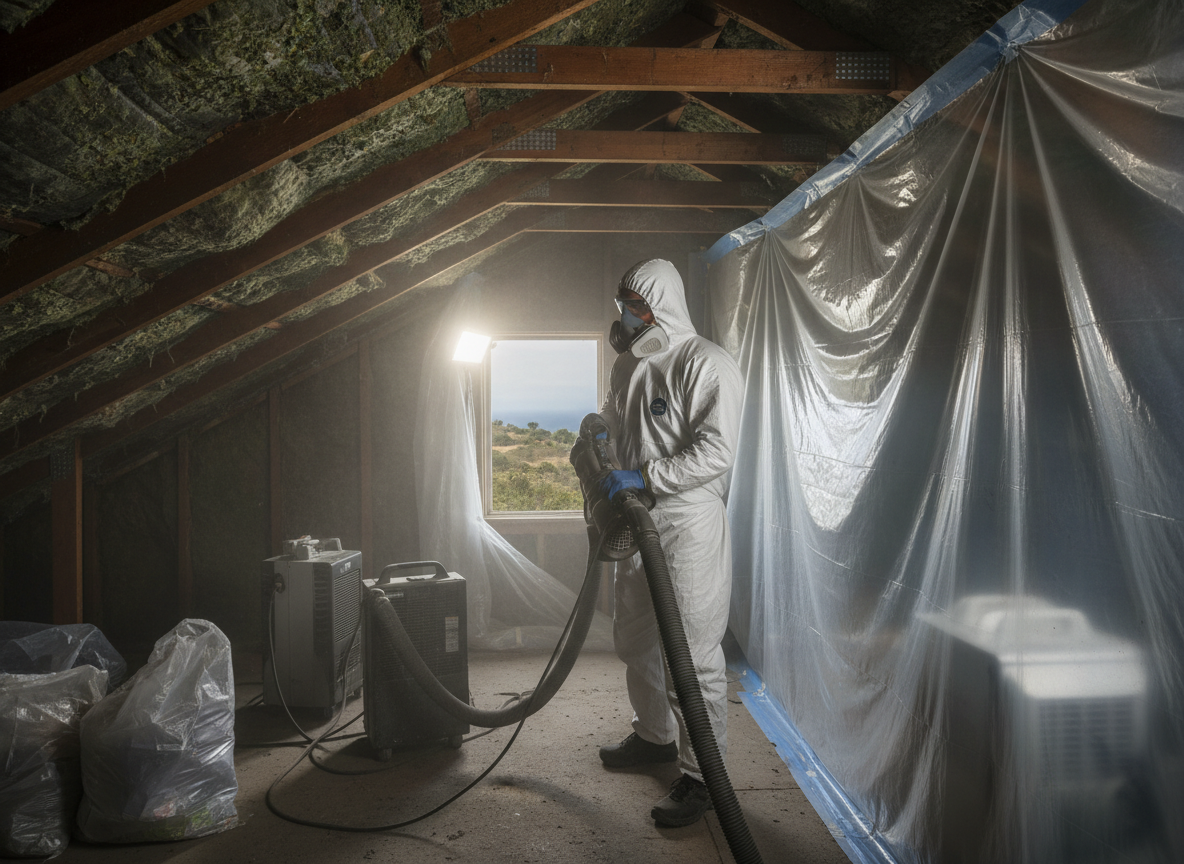
Palos Verdes Peninsula homes, especially those in Palos Verdes Estates and Rolling Hills Estates built before the 1980s, often feature vented attics with original fiberglass insulation that traps condensation from year-round ocean breezes. These breezes carry salt-laden air that accelerates corrosion on metal flashing and roof penetrations, allowing small roof leaks to go unnoticed until mold colonies form on rafters and sheathing. Remediation requires negative-air containment to prevent spores from migrating into living spaces below, followed by HEPA vacuuming and antimicrobial treatment on wood surfaces without disturbing the structural integrity of older lath-and-plaster ceilings.
Terrain plays a direct role on jobs in Portuguese Bend and Lunada Bay, where steep slopes cause differential settling that cracks roof decks and shifts attic vents. Technicians must inspect for hidden water intrusion along the uphill side of the home first, because gravity-fed runoff frequently pools against the highest point of the attic. Removing affected insulation demands careful bagging to avoid cross-contamination, and replacement materials must account for the mild Mediterranean climate that keeps relative humidity elevated even in winter, slowing natural drying times compared to inland Los Angeles County neighborhoods.
Edge cases include mold growth on spray-foam insulation retrofits common in Rancho Palos Verdes remodels; these closed-cell products can hide active growth behind the foam layer, requiring moisture metering and borescope inspection before any removal begins. Code considerations in Los Angeles County require proper disposal of contaminated materials at approved facilities and documentation of moisture source correction, since simply cleaning without fixing the roof leak will lead to rapid recurrence during the next marine layer event.
Technician insight
In Palos Verdes Peninsula, the thing that catches most people out with attic mold remediation is how ocean breezes push salt air through aging roof vents on hillside homes in Portuguese Bend and Rolling Hills, letting condensation form on the uphill rafters months before any ceiling stain appears downstairs.
Rolling Hills Estates Attic Growth
Homeowner noticed musty odor after heavy marine layer. Inspection found roof leak at vent flashing on the slope side allowing water to run along rafters. Crew contained the attic, removed saturated insulation, treated framing, and confirmed drying before reinstalling new insulation. Odor resolved and no recurrence during following winter marine layers.
How it works
- 1
Initial Assessment
Technician performs moisture mapping and borescope inspection of attic spaces in Palos Verdes Peninsula homes, identifying active leaks tied to ocean-breeze exposure and hillside settling.
- 2
Containment Setup
Negative-air machines and plastic barriers isolate the attic to prevent spore migration into living areas of older homes in Rolling Hills Estates and Rancho Palos Verdes.
- 3
Mold Removal
HEPA vacuuming, antimicrobial application, and removal of affected insulation occur while protecting original wood rafters common in pre-1980s Palos Verdes construction.
- 4
Drying and Verification
Industrial dehumidifiers and air movers dry the space; post-remediation testing confirms moisture levels return to safe ranges given the area's persistent ocean humidity.
- 5
Source Correction Guidance
Report details roof or vent repairs needed to stop recurrence from marine-layer moisture in neighborhoods such as Lunada Bay.
Pricing
Cost depends on attic size, extent of hidden growth behind insulation, and access challenges on sloped lots in Palos Verdes Peninsula.